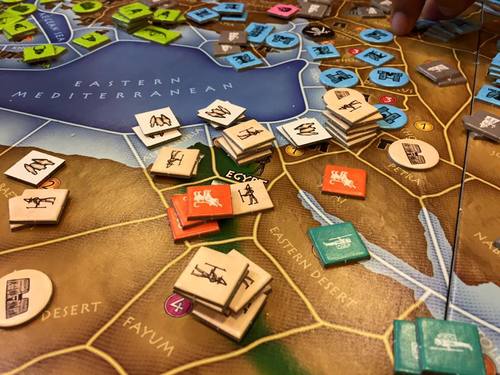
In 2015 I bought a big wooden box from Funagain Games. Inside was MEGA CIV. The latest iteration of the game that was Advanced Civilization. The game that inspired Sid Meier to create the Civilization video game series. And for years I kept that box on my shelf, unplayed.
After all, the learning game was SIX HOURS long and took as many players as a regular game of Twilight Imperium. How could I get people to agree to that, much less find the seventeen other people I would beed for a full game? And a few years ago I sold that box and gave up on the idea of ever playing.
Then, in twenty twenty six, my main boardgame group and close friends decided to attend GameStorm in Portland, Oregon. A couple of us had been going to PAX for a few years but life circumstances make the cost quite prohibitive. Here was a local convention that cost sixty dollars for four days of dedicated gaming!
I hurried off to the schedule to see what games I could sign up for. I scrolled past six or so games of Twilight Imperium, signed up to play Clash of Cultures and … there it was. Friday. Fourteen hours. MEGA CIV.
I immediately signed up. I told my friends and my family that I’d be playing all day. Also that they should join me. But, of course, I had no expectation that anyone else would join me in this madness. All day, charting the rise of fall of ancient empires? Trading in the Mediterranean? Glorious.
The day arrived. I showed up at 8:30am promptly for the teach. The game was very simple, it turns out. I’d taken some of components out of my original box of the years. Looked at them in awe. Read a few pages of rulebook. Put them back. But this was … simple. Certainly much more simple than something like Civolution.
Essentially a trading game, Mega Civ had very straightforward mechanics for expanding your population, founding cities, traveling, feeding people, going to war. Everything was mechanical. There were no dice.
There were twelve other people there that day. Many of them gathered every year to play this. And it would be the only time that year they would be able to play in person. Many, like me, were first timers. All of us grognards, drawn by the promise of an epic experience.
I played the Iberians. Having only two neighbors I could exist in relative peace while trying to do the best I could for my burgeoning empire and learning the game.
The trading. The trading is everything. And it is brutal.
The rules are simple:
You draw as many resource cards as you have cities.
Each of those cards will have a level.
Each of them will either show a resource or a calamity.
Trade freely with every other person, trying to trade away calamities and gather sets of resources that you will then sell to buy technologies that give you special powers.
Each trade must consist of at least three cards.
You must be honest about two of them.
And within those simple rules, the entire world of the game rotates. As thirteen people try to find sets of cards, shouting ‘Wool’ or ‘Wood’ or ‘Gems’ while secretly stabbing each other in the back by trading each other ‘Barbarian Hordes’ or ‘Superstition’ cards to destroy each others cities.
After trading each person much deal with their calamities as the entire room looks on.
After fourteen hours, the end game was triggered. We counted our points (I ended at a reasonable 103, a number I still remember two weeks on, while the winner ended at 160) and said goodbye.
Some of the more adventurous people went to find another game. I went to find my bed.
The game lived up to all of my expectations. It was epic. It told a story. It emerged out of the interplay between people rather than just the execution of mechanics. It represents the best of 1970’s era American board game design. The same school that thought up Dune. It was a wonderful way to spend a day among a bunch of other middle aged weirdos who loved the small chits, the oversized cards, the tangled web of technological advancement, and the camaraderie.
And it everything goes well, I’ll be back next year.